


Biography
‘The Nabi Shock’ brings together over 20 paintings by leading figures of the Nabi movement, Émile Bernard, Pierre Bonnard, Maurice Denis, Charles Filiger, Paul Ranson, József Rippl-Ronai, Ker-Xavier Roussel, Paul Sérusier and Édouard Vuillard, drawing on Waddington Custot’s expertise in this strand of European modernism. The paintings all date from that remarkably fertile period between 1888 and 1900, when the Nabis were actively working together in Paris. Here, Waddington Custot presents them alongside new paintings by Marcel.la Barceló, Ben Arpéa, Ian Davenport, Marcel Dzama, François Réau, Anne Rothenstein and Fabienne Verdier. This juxtaposition foregrounds the striking relevance of the Nabi aesthetic today, where colour, rhythm and interiority remain driving forces.
In just 12 years, the Nabis radically redefined the possibilities of painting. Adopting the burgeoning view, as articulated by Denis, that a ‘painting – before being a warhorse, a nude woman, or an anecdote of any kind – is essentially a flat surface covered with colours, assembled in a certain order’, they heralded an artistic renewal. Paintings such as Bonnard’s ‘Étude pour ‘Le Corsage à carreaux’’ (1892) and Vuillard’s ‘La Chambre verte, rue Truffaut’ (c.1900–01) are characterised by flat planes of unmodulated colour, distinctive outlines and textured surfaces that give Nabi painting its rhythm.
Underneath its painterly aesthetic, the work of the Nabi drew from the nascent theories of the subconscious developed by Sigmund Freud. Rather than depicting reality as it appeared before them, they wished to convey the experience of being enveloped in the world, engaging the viewer emotionally through the richness of the colours and the tactile quality of the brushstrokes. Guided by this interest in the inner life, Nabi subjects were often drawn from the immediate and personal: sisters, wives and mothers, or occasionally a celebrated stage actor. Most appear in quiet interiors or secluded gardens, exemplified by Roussel’s ‘Femmes au jardin’ (c.1893–95) and ‘Femme lisant’ (1895) by Vuillard.
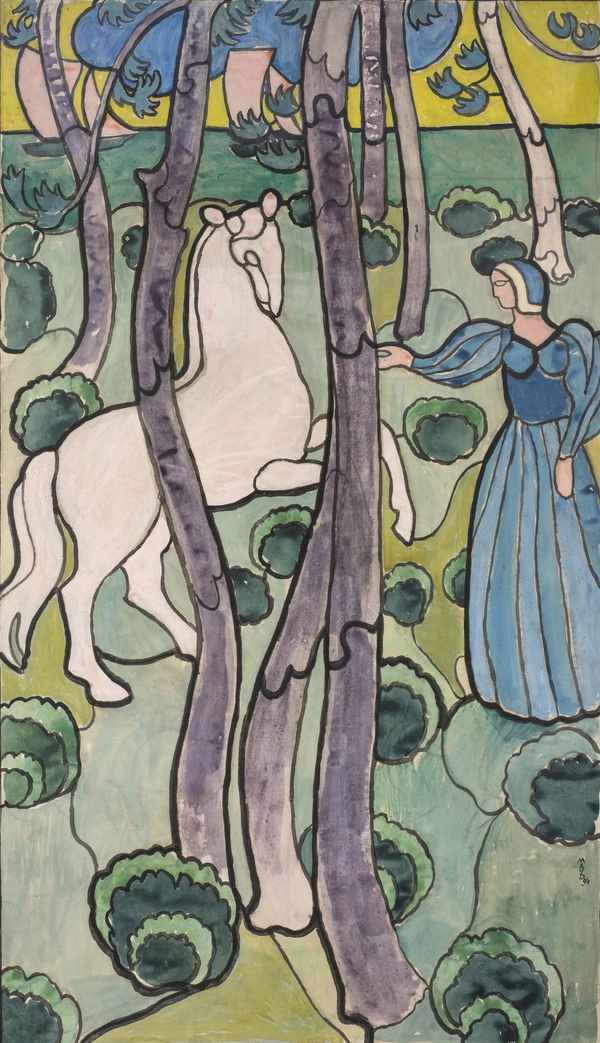
The Nabis’ interests were wide-ranging: beyond canvases and works on paper, they designed theatre sets, posters and textiles. The exhibition presents Denis’ impressive stained-glass design ‘Le Cheval blanc’ (1894), Bonnard's illustrations for musical scores and concert programmes, and Ranson's Japanese-inspired ‘Le Grand Tigre’ (1893), a work that migrated from paper into carpets and painting.
Today, the Nabis generate significant institutional attention. In recent years, their work has been the subject of major museum exhibitions across Europe and the United States, and Waddington Custot has played a significant role in this revival, exhibiting the Nabis at Frieze in London (2024) and at the gallery in Paris (2026).
As the purely formal tendencies of late 20th-century art have given way to poetic explorations of lived experience, artists are once again looking at the world with an imaginative sensibility. In this exhibition, Waddington Custot’s curation spotlights the clear resonance between the Nabi and contemporary painting, where figuration, emotional depth and richly worked surfaces come to the fore. Barceló’s sinuous lines recall Denis’ lampshade designs, themselves inspired by Japanese printmaking, a sensibility echoed in the rich surfaces of Dzama’s watercolours. Davenport’s exploration of colour relationships echoes Filiger’s chromatic studies, while landscapes by Arpéa and Rothenstein bring to mind Vallotton’s distinctive paysage composé approach to sunsets and nocturnal scenes. Réau and Verdier, meanwhile, extend Vuillard’s philosophical conception of the world in which interior experience and external reality are in constant dialogue.
Waddington Custot presents ‘The Nabi Shock’, celebrating the living history of a group that transformed modern painting with extraordinary boldness, and places it amongst a new generation of artistic visionaries who reflect or reimagine that spirit.
Lire plus
-
 Maurice Denis, Le Cheval blanc (projet de vitrail), 1894
gouache on paper laid on canvas
55 1/8 x 33 1/2 in
140 x 85 cm
Maurice Denis, Le Cheval blanc (projet de vitrail), 1894
gouache on paper laid on canvas
55 1/8 x 33 1/2 in
140 x 85 cm
-
Fabienne Verdier , Sure une ile lointaine, 2025
acrylic and mixed media on canvas
6 3/8 x 9 1/4 in
16 x 23.5 cm
%3Cdiv%20class%3D%22artist%22%3E%3Cspan%20class%3D%22artist%22%3E%3Cstrong%3EFabienne%20Verdier%20%3C/strong%3E%3C/span%3E%3C/div%3E%0D%3Cdiv%20class%3D%22title%22%3E%3Cem%3ESure%20une%20ile%20lointaine%3C/em%3E%2C%202025%3C/div%3E%0D%3Cdiv%20class%3D%22medium%22%3Eacrylic%20and%20mixed%20media%20on%20canvas%3C/div%3E%0D%3Cdiv%20class%3D%22dimensions%22%3E6%203/8%20x%209%201/4%20in%3Cbr%20/%3E%0A16%20x%2023.5%20cm%3C/div%3E
-
Paul Serusier, Bretonne allaitant, 1892
oil on canvas
28 3/4 x 21 5/8 in
73 x 55 cm
%3Cdiv%20class%3D%22artist%22%3E%3Cspan%20class%3D%22artist%22%3E%3Cstrong%3EPaul%20Serusier%3C/strong%3E%3C/span%3E%3C/div%3E%0D%3Cdiv%20class%3D%22title%22%3E%3Cem%3EBretonne%20allaitant%3C/em%3E%2C%201892%3C/div%3E%0D%3Cdiv%20class%3D%22medium%22%3Eoil%20on%20canvas%3C/div%3E%0D%3Cdiv%20class%3D%22dimensions%22%3E28%203/4%20x%2021%205/8%20in%3Cbr%20/%3E%0A73%20x%2055%20cm%3C/div%3E
-
Ian Davenport, Notation Chromatic, 2026
acrylic on aluminium mounted onto aluminium panel
23 5/8 x 19 3/4 in
60 x 50 cm
%3Cdiv%20class%3D%22artist%22%3E%3Cspan%20class%3D%22artist%22%3E%3Cstrong%3EIan%20Davenport%3C/strong%3E%3C/span%3E%3C/div%3E%0D%3Cdiv%20class%3D%22title%22%3E%3Cem%3ENotation%20Chromatic%3C/em%3E%2C%202026%3C/div%3E%0D%3Cdiv%20class%3D%22medium%22%3Eacrylic%20on%20aluminium%20mounted%20onto%20aluminium%20panel%3C/div%3E%0D%3Cdiv%20class%3D%22dimensions%22%3E23%205/8%20x%2019%203/4%20in%20%3Cbr%20/%3E%0A60%20x%2050%20cm%3C/div%3E
-
Charles Filiger, Notation chromatique, 1905–18
watercolour, gouache and pencil on paper [double-sided]
9 5/8 x 10 1/2 in
24.4 x 26.7 cm
%3Cdiv%20class%3D%22artist%22%3E%3Cspan%20class%3D%22artist%22%3E%3Cstrong%3ECharles%20Filiger%3C%2Fstrong%3E%3C%2Fspan%3E%3C%2Fdiv%3E%0D%3Cdiv%20class%3D%22title%22%3E%3Cem%3ENotation%20chromatique%3C%2Fem%3E%2C%201905%E2%80%9318%3C%2Fdiv%3E%0D%3Cdiv%20class%3D%22medium%22%3Ewatercolour%2C%20gouache%20and%20pencil%20on%20paper%20%5Bdouble-sided%5D%3C%2Fdiv%3E%0D%3Cdiv%20class%3D%22dimensions%22%3E9%205%2F8%20x%2010%201%2F2%20in%3Cbr%20%2F%3E%0A24.4%20x%2026.7%20cm%3C%2Fdiv%3E
-
Anne Rothenstein, Sunset, 2023
oil on wooden panel
48 x 60 in
122 x 152.5 cm


The Artistic Brotherhood of Les Nabis
1888–1900


