Biography
Opening this April, Waddington Custot is proud to present its 14th solo exhibition of works by French artist Jean Dubuffet (1901–85), a celebration of the gallery’s longstanding relationship with the artist and his Estate, spanning over 50 years since hosting his first British solo show in 1972.
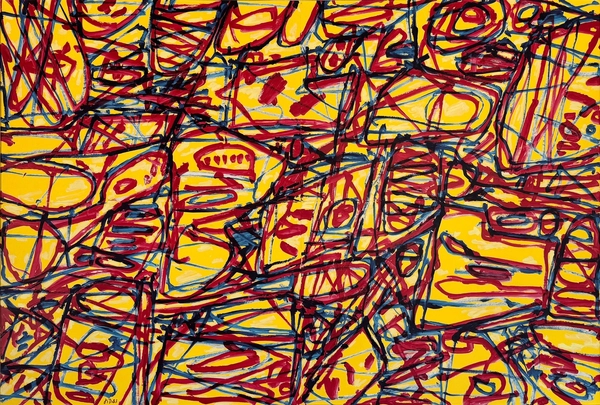
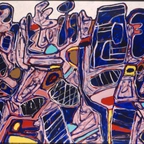
‘Jean Dubuffet: The Last 10 Years’ brings together a focused selection of paintings from the radical final chapter of his career. Even as his health declined, Dubuffet remained remarkably productive, creating works that continued to push artistic boundaries and challenge the way we see the world. Here, these significant artistic achievements are explored in 17 pivotal paintings made between 1975 and 1984, highlighting a period of great experimentation. During these years, Dubuffet re-examined the visual language he had developed over four decades, loosening previous structures, exploring new colours and blending abstraction with figuration in ways that were at once playful and thought-provoking.
The earliest paintings on display, ‘Paysage avec 6 personnages’ and ‘Paysage avec 4 personnages’ (both from 1975), return to the perennial theme of Dubuffet’s long career: figures embedded within abstracted landscapes. Continuing Dubuffet’s early exploration of terrain as layered bands of form and colour, they present figures beneath high horizon lines immersed in, and at one with, the soil. These paintings are notable for their vibrant and explosive use of yellow and pink, colours largely absent during the long L’Hourloupe years, when white and black, blue and red dominated. Dubuffet’s tense L’Hourloupe vocabulary begins to loosen: landscapes and figures coexist in fluid systems.
Continuing this circulatory action, four collage pieces from the Théâtre de la Mémoire series (mid-late 1970s) show Dubuffet revisiting earlier motifs, which he paints onto pieces of paper and assembles into layered compositions. Erasing horizon lines entirely, these pieces create scenes that defy time and space. Characters from past series drift into the compositions, transforming each one into a self-reflective exploration of Dubuffet’s oeuvre. Highlights include ‘Le Malentendu’ (23 December 1976), a masterpiece of layered colour, fragmentary forms and temporal freedom.
Dubuffet’s Sites and Psycho-sites series (1981–82), represented here by seven paintings, transport viewers into imagined, indeterminate spaces. Figures float through elusive landscapes coloured in expressive palettes. Dubuffet described these works as representing “ideas of characters who populate ideas of sites… an enterprise aimed at escaping the reasonable, at freeing the figuration and hence the vision.” Here, Dubuffet challenges perception itself, creating compositions that feel alive and unpredictable. In ‘Site aléatoire avec 6 personnages’ (5 May 1982), he blurs the line between figure and landscape to such an extent that figures fuse with ground, hovering ghostlike on the verge of disappearance. At the threshold of abstraction, they form a meditation on presence, absence and our connection to the earth.
In two striking paintings from the Mires series (1983), Dubuffet continues to experiment with immersive colour fields, collapsing space in abstract compositions where line, volume, void and colour intermingle. ‘Mire G 136 (Kowloon)’, a rare, large-scale, bright yellow work, evokes Dubuffet’s imagined impressions of Chinese shop signs and ceremonial banners in Hong Kong. The ‘Mire (Boléro)’, a deep, resonant red, depicts a fragmented pictorial space. These paintings, fully abstract with figures entirely dissolved into the earth, buzz with an almost atomic energy. Dubuffet seems to be magnifying the world to its most elemental level, capturing a sense of intensity and unstoppable motion.
Finally, ‘Jean Dubuffet: The Last 10 Years’ concludes with ‘Champ Psychophysique’ from 1984, part of Dubuffet’s Non-lieux series. It represents a psychophysical field, merging perception, sensation and material reality. Figures and any sense of place or the surrounding landscapes have dissolved entirely, evoking cycles of emergence, presence and disappearance. The work reflects Dubuffet’s interest in terroir and our inseparable bond with the land – his last meditation on how humans inhabit, are inseparable from and eventually become, their environment.
A fearless iconoclast, Jean Dubuffet emerged from the devastation of the Second World War with a single determination: to obliterate tradition and remake art on his own terms. He rejected academic polish and conventional beauty, favoring raw, immediate and often confrontational expression. His late paintings concentrate this radicalism to its purest form, creating psychological landscapes that defy literal representation. ‘Jean Dubuffet: The Last 10 Years’ reveals an artist who never ceased to reinvent himself, pushing Art Brut to new extremes, mining the raw energy of human experience and challenging the very foundations of how we see and feel the world, right up to the final moments of his life.
This is Dubuffet at his most inventive and alive – a chance to experience the work of a master redefining his art in real time.
‘Jean Dubuffet: The Last 10 Years’ coincides with an exhibition on the same defining years, ‘Pulsions, Jean Dubuffet, the final years (1974-1985)’, at the Fondation Dubuffet, Paris, France, opening on 16 April 2026.
继续
作品
-
 Jean Dubuffet, Le malentendu 23 décembre 1976, 1976
acrylic on collaged canvas-backed paper mounted on canvas
27 3/4 x 40 1/4 in
70.4 x 102.2 cm
%3Cdiv%20class%3D%22artist%22%3E%3Cspan%20class%3D%22artist%22%3E%3Cstrong%3EJean%20Dubuffet%3C%2Fstrong%3E%3C%2Fspan%3E%3C%2Fdiv%3E%0D%3Cdiv%20class%3D%22title%22%3E%3Cem%3ELe%20malentendu%2023%20d%C3%A9cembre%201976%3C%2Fem%3E%2C%201976%3C%2Fdiv%3E%0D%3Cdiv%20class%3D%22medium%22%3Eacrylic%20on%20collaged%20canvas-backed%20paper%20mounted%20on%20canvas%3C%2Fdiv%3E%0D%3Cdiv%20class%3D%22dimensions%22%3E27%203%2F4%20x%2040%201%2F4%20in%3Cbr%20%2F%3E%0A70.4%20x%20102.2%20cm%3C%2Fdiv%3E
Jean Dubuffet, Le malentendu 23 décembre 1976, 1976
acrylic on collaged canvas-backed paper mounted on canvas
27 3/4 x 40 1/4 in
70.4 x 102.2 cm
%3Cdiv%20class%3D%22artist%22%3E%3Cspan%20class%3D%22artist%22%3E%3Cstrong%3EJean%20Dubuffet%3C%2Fstrong%3E%3C%2Fspan%3E%3C%2Fdiv%3E%0D%3Cdiv%20class%3D%22title%22%3E%3Cem%3ELe%20malentendu%2023%20d%C3%A9cembre%201976%3C%2Fem%3E%2C%201976%3C%2Fdiv%3E%0D%3Cdiv%20class%3D%22medium%22%3Eacrylic%20on%20collaged%20canvas-backed%20paper%20mounted%20on%20canvas%3C%2Fdiv%3E%0D%3Cdiv%20class%3D%22dimensions%22%3E27%203%2F4%20x%2040%201%2F4%20in%3Cbr%20%2F%3E%0A70.4%20x%20102.2%20cm%3C%2Fdiv%3E -
Jean Dubuffet, Voie piétonnière 20 janvier 1981, 1981
acrylic on canvas
39 x 31 3/4 in
100 x 81 cm
%3Cdiv%20class%3D%22artist%22%3E%3Cspan%20class%3D%22artist%22%3E%3Cstrong%3EJean%20Dubuffet%3C%2Fstrong%3E%3C%2Fspan%3E%3C%2Fdiv%3E%0D%3Cdiv%20class%3D%22title%22%3E%3Cem%3EVoie%20pi%C3%A9tonni%C3%A8re%20%2020%20janvier%201981%3C%2Fem%3E%2C%201981%3C%2Fdiv%3E%0D%3Cdiv%20class%3D%22medium%22%3Eacrylic%20on%20canvas%3Cbr%20%2F%3E%0A%3C%2Fdiv%3E%0D%3Cdiv%20class%3D%22dimensions%22%3E39%20x%2031%203%2F4%20in%3Cbr%20%2F%3E%0A100%20x%2081%20cm%3C%2Fdiv%3E
-
Jean Dubuffet, Douteuse spécificité des lieux 19 novembre 1979, 1979
acrylic on paper on canvas
24 7/8 x 27 1/4 in
63 x 69 cm
%3Cdiv%20class%3D%22artist%22%3E%3Cspan%20class%3D%22artist%22%3E%3Cstrong%3EJean%20Dubuffet%3C%2Fstrong%3E%3C%2Fspan%3E%3C%2Fdiv%3E%0D%3Cdiv%20class%3D%22title%22%3E%3Cem%3EDouteuse%20sp%C3%A9cificit%C3%A9%20des%20lieux%2019%20novembre%201979%3C%2Fem%3E%2C%201979%3C%2Fdiv%3E%0D%3Cdiv%20class%3D%22medium%22%3Eacrylic%20on%20paper%20on%20canvas%3C%2Fdiv%3E%0D%3Cdiv%20class%3D%22dimensions%22%3E24%207%2F8%20x%2027%201%2F4%20in%3Cbr%20%2F%3E%0A63%20x%2069%20cm%3C%2Fdiv%3E
-
Jean Dubuffet, L’heure de pointe 8 décembre 1980, 1980
acrylic on canvas
39 3/8 x 31 7/8 in
100 x 81 cm
%3Cdiv%20class%3D%22artist%22%3E%3Cspan%20class%3D%22artist%22%3E%3Cstrong%3EJean%20Dubuffet%3C%2Fstrong%3E%3C%2Fspan%3E%3C%2Fdiv%3E%0D%3Cdiv%20class%3D%22title%22%3E%3Cem%3EL%E2%80%99heure%20de%20pointe%208%20d%C3%A9cembre%201980%3C%2Fem%3E%2C%201980%3C%2Fdiv%3E%0D%3Cdiv%20class%3D%22medium%22%3Eacrylic%20on%20canvas%3C%2Fdiv%3E%0D%3Cdiv%20class%3D%22dimensions%22%3E39%203%2F8%20x%2031%207%2F8%20in%3Cbr%20%2F%3E%0A100%20x%2081%20cm%3C%2Fdiv%3E
-
Jean Dubuffet, Mire G 136 (Kowloon) 25 septembre 1983, 1983
acrylic on canvas backed paper
52 3/4 x 78 3/4 in
134 x 200 cm
%3Cdiv%20class%3D%22artist%22%3E%3Cspan%20class%3D%22artist%22%3E%3Cstrong%3EJean%20Dubuffet%3C/strong%3E%3C/span%3E%3C/div%3E%0D%3Cdiv%20class%3D%22title%22%3E%3Cem%3EMire%20G%20136%20%28Kowloon%29%2025%20septembre%201983%3C/em%3E%2C%201983%3C/div%3E%0D%3Cdiv%20class%3D%22medium%22%3Eacrylic%20on%20canvas%20backed%20paper%3C/div%3E%0D%3Cdiv%20class%3D%22dimensions%22%3E52%203/4%20x%2078%203/4%20in%20%3Cbr%20/%3E%0A134%20x%20200%20cm%3C/div%3E